Valie Export
Monday, 31 January 2011
Installation pt. 1 (White Cubicle)
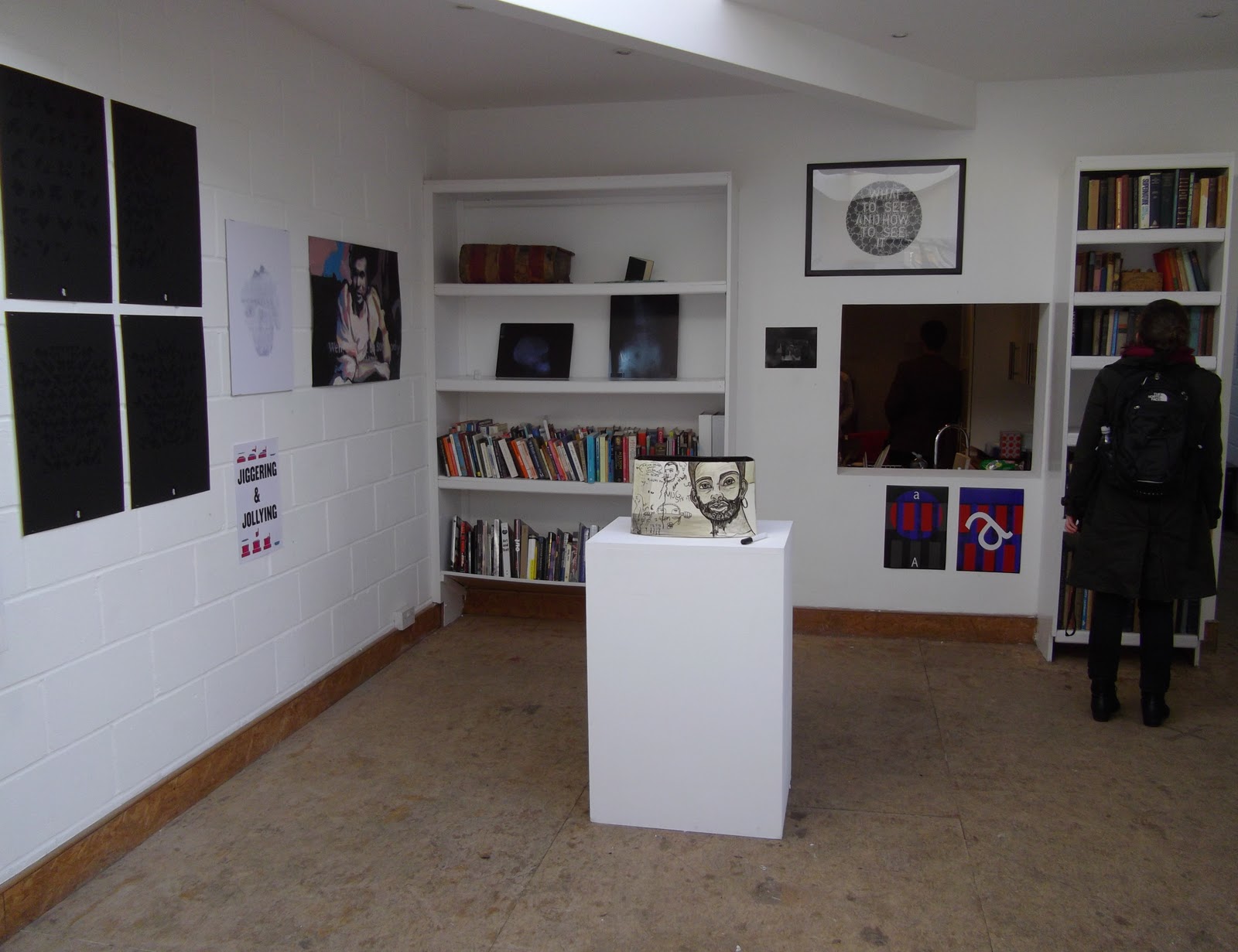
Part 1 of my installation a large drawing from a photograph of my latex body landscapes...
approx. 1m wide and 1.7m heigh done in charcoal on paper.
Intintail peeling problems because I had to try and staple on a door which needed to be closed...
but I sorted it out :)
Sunday, 30 January 2011
Re-visiting John Copland's work
Self-Portrait (Back with Arms Above) 1984
Photograph on paper
image: 1213 x 935 mm
on paper, print
Presented by the American Fund for the Tate Gallery, courtesy of Marsha Plotnitsky 2000
Self-Portrait (Hands Spread on Knees) 1985
Photograph on paper
image: 968 x 1108 mm
on paper, print
Presented by the American Fund for the Tate Gallery, courtesy of Marsha Plotnitsky 2000
Self-Portrait (Torso, Front) 1984
Photograph on paper
image: 1156 x 817 mm
on paper, print
Presented by the American Fund for the Tate Gallery, courtesy of Marsha Plotnitsky 2000
Coplans photographs explore his own body. In a seemingly brash manner he confronts us with the ageing process and contrasts more conventional images of the body in the as an object of beauty.
Coplans depersonalises the photographs by excluding his face, focus is placed on sections of the body, rather than the body as a whole. Often the arrangements become quite humorous and bizarre; in Self-Portrait (Back with Arms Above) 1984 (shown at the top of this post) Coplans body appears like a rock, his fists as if independent of his body/rock
Saturday, 29 January 2011
Female Photographers
CINDY SHERMAN
Cindy Sherman, Untitled, 1982 (c type photo)
'By turning the camera on herself, Cindy Sherman has built a name as one of the most respected photographers of the late twentieth century. Although, the majority of her photographs are pictures of her, however, these photographs are most definitely not self-portraits. Rather, Sherman uses herself as a vehicle for commentary on a variety of issues of the modern world: the role of the woman, the role of the artist and many more. It is through these ambiguous and eclectic photographs that Sherman has developed a distinct signature style. Through a number of different series of works, Sherman has raised challenging and important questions about the role and representation of women in society, the media and the nature of the creation of art.'
HANNAH WILKE
Hannah Wilke Super-t-Art 1974
Photographic Work
'Hannah Wilke is known for her photographic work of performances in which she used her own body, and she established herself as both the artist and the subject of her work. Wilke created "Hannah Wilke Super-t-Art" using 20 images from her 1974 live perfomance at the Kitchen, New York, and she created the 1976 photographic triptych "Gestures," using stills from her 1974 videotaped performance. Wilke coined the term "Performalist Self-Portrait" to describe photographic work she created and directed others to photograph, including the 1975 "S.O.S. Starification Object Series," "I Object, Memoirs of a Sugar Giver,"1977, "So Help Me Hannah," 1978, and "Intra Venus," 1993.'
Friday, 28 January 2011
Burnt biscuits, the story of my life...
So for the last session of my text and image elective I decided to bake some biscuits in the shape of speech bubbles... after deciding they weren't quite cooked enough I put them in the oven for a further three minutes at a higher temperature and I proceeded to burn all but 5 of them! :(
(the photo shows a selection of the burnt ones, the bottom of the biscuits were pretty much black!)
I think there's something quite funny about eating a speech bubble, it sort of implies a stifling, eating one's own words or perhaps chewing over something someone has said...?
My tutor told me about an installation by Philippe Parreno, where he created 'real' speech bubble balloons. The absence of any speech upon them, as with my biscuits, I think makes them an open invitation to the viewer mentally projecting their own words onto the bubble. It would have been interesting if people could have had more interaction with the bubbles- as balloons I would like to have attached string to each so that the viewer could take possession of a bubble in the way a person could eat my bubble biscuits...
1997, ballons en mylar, helium
I also 'collaborated' with a fellow text and image student's (Brigid Deacon) biscuits for my own entertainment...
Tuesday, 25 January 2011
Sound workshop
We had a very interesting talk and workshop today led by Maryclare Foa (here's a link to her website)
Rupert Sheldrake talked about perceiving the world and as you perceive the world it perceives you.
The self has one fixed p.o.v. yet is seen from a multitude of directions...
If I have a memory, an imprint of a place then are the places imprinted with me?
Hamish Fulton and Richard long made a walking drawing, I made a video of me walking, but holding the camera's lanyard so that it was left free to dangle and record a multitude of angles as I moved. I then cropped the video to show only when the camera was aimed at me as I walked. This left a jerky collection of shots showing mainly my legs and bag as I made my journey.
I think there is potential for more work of a similar nature- I feel that the dangling camera acts as a drawing tool that I have relinquished control of... I accidentally left my camera filming last week, and ended up with a rather unfortunate video that repeatedly flashed shots of crotch as the camera dangled from my wrist. Although not ideal subject matter, these weird angle glimpses of my body proved quite intriguing.
Monday, 24 January 2011
Kings Cross mural
We have been asked by Jim Geddes' landlord to create a mural on a shop front in Kings Cross.
The idea we settled on today was to use photographs found in the basement of Jim Geddes studio (of the White Cubicle) as inspiration for our painting.
Sunday, 23 January 2011
Hannah Biscombe
http://www.artbelow.org.uk/artists/hannahbiscombe
photograms - a primitive photographic technique that records the space around objects on paper
Saturday, 22 January 2011
APPROACH
I had a wonderful day helping out at Bend in the River's stand at London Art fair today!
It was extremely interesting spending the day observing the interactions and body language of potential collectors/buyers and the average fair goer- I'm just looking, I'm not buying, I'm just looking, keeps me smiling...
Bob Billington's work (below) was very popular and regularly drew the intrigue of passers by who all approached the work in the same manner- moving close to the surface and then craning their heads round the edge of the work which was displayed raised, as if floating, on the wall.

Susan Michie's work also received a lot of attention, the tiny circles meticulously drawn over 14 sheets of paper (7 of which BITR were showing) appear like a translation of Michie's subconscious. It was not surprising to see people mesmerised by the patterns, moving very close to the surface of the drawings. The marks flow as they form accidental areas of density which from afar build up line.
To The Edge, detail, 2010
Friday, 21 January 2011
Wednesday, 19 January 2011
DISAPPEAR
ways of drawing indirectly. dislodging.
Drawings made of dust from scraping a conte crayon and a charcoal block then blowing away areas of dust to add highlights and shape the marks. I then blew all the dust away.
Interestingly enough the photos decided to disappear from my camera memory card...leaving me with naught but the trace of dust on the fabric!
Tuesday, 18 January 2011
Fumage
Pigment
Anish Kapoor made a series of carefully constructed piles of pigment.............
Anish Kapoor, 1000 Names, 1979-80
Anish Kapoor, Mother as a Mountain, 1985.
Dust Breeding
Man Ray, Elvage de poussiere (Dust Breeding), 1920
This photo, taken by Man Ray, shows a layer of dust that had been purposefully allowed to build up on the surface of Marcel Duchamp's unfinished piece 'Large Glass'.
(The original photo before it was cropped)
(Curve templates, that Duchamp probably used while making large glass, can be seen at the bottom of this photo)
SMASHED
the glass cracked in the frame I JUST BOUGHT. I am very upset. but I will have to display the photo without...
Monday, 17 January 2011
Untitled (Shakespeare)
...the three cropped photos of my drawing-
I am going to get the middle one printed to A2... I think it looks the best quality and I like the large space of bare latex at the bottom, it makes the dark marks appear more precarious, reflecting the ephemeral nature of the drawing.

For the show...
the plan-
Untitled (Shakespeare), 2010
framed digital photographic print and caption
(frame) 73 cm x 103 cm (image) 59.4 x 42.0 cm (A2)
Due to it's ephemeral nature, most of my work exists as documentation (such as this photo). Untitled (Shakespeare) is a photograph of a drawing made in graphite dust spread over sheet latex. I created the marks and patterns by pressing and moving my body behind the latex screen. Usually I am interested in creating ambiguous images. However in this piece, inspired by a recent lecture on reading drawings, by Stephen Farthing, and my learning during this text and image elective, I have used a caption to direct the viewer's 'reading' of the image.
Subscribe to:
Posts (Atom)